Sinasos: A Living Archive

.png)
Among Cappadocia’s historic settlements, Sinasos today known as Mustafapaşa stands apart as one of Anatolia’s most sophisticated examples of cultural continuity. For centuries, the village developed as a center of trade, education, religion, craftsmanship, and intellectual life, creating a settlement whose influence extended far beyond its physical scale.
Unlike many historic destinations that are remembered through a single monument, Sinasos is remarkable because it functions as an entire cultural landscape.
Its churches, monasteries, educational institutions, mansions, bridges, courtyards, and carved stone houses collectively tell the story of a community shaped by exchange between civilizations.
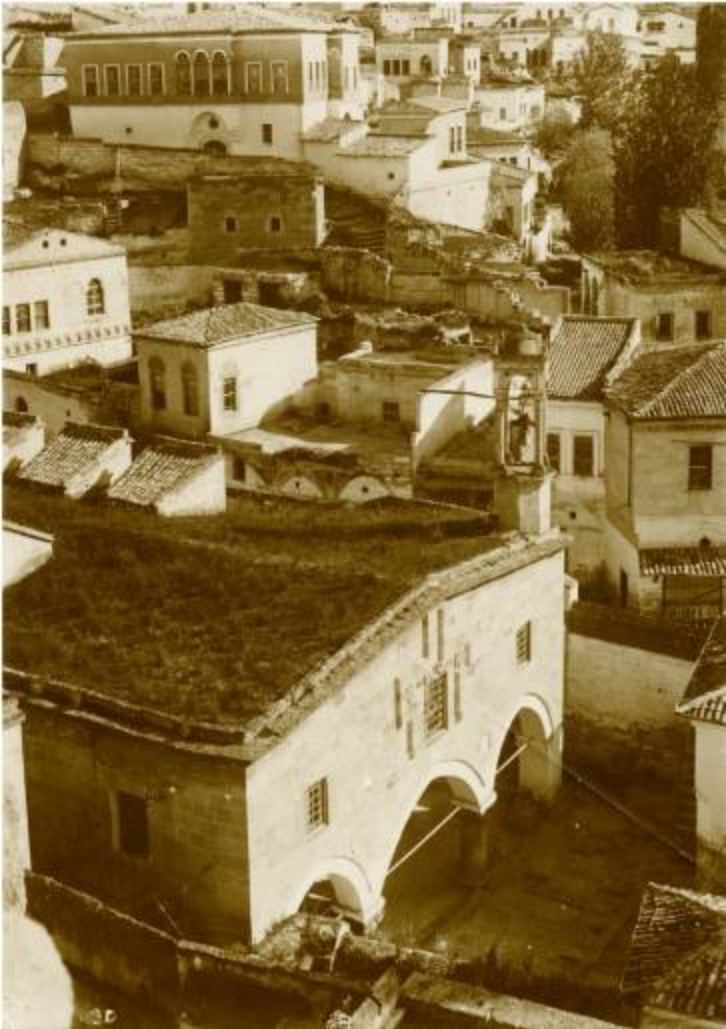
The prosperity of the region, supported in part by merchant families connected to Istanbul and international trade networks, helped finance an extraordinary architectural legacy. Many of the village’s celebrated Anatolian Greek houses still feature elaborately carved stone portals and entrances that remain among the finest examples of civil architecture in Cappadocia.
These doors were more than decorative elements.
They were symbols of education, prosperity, craftsmanship, and identity.
Yet Sinasos was not only an architectural center.
It was also a center of learning.
Schools, religious institutions, and community buildings played a central role in village life, creating a culture that placed significant importance on education and intellectual development. This heritage remains visible today through the scale and ambition of many public structures that survive within the settlement.
Religious heritage forms another essential layer of Sinasos' identity.
The village occupies a unique position within Cappadocia's Christian history, surrounded by churches, monasteries, pilgrimage routes, and sacred landscapes that developed over centuries.
One of the most significant examples is the Saint Nicholas Monastery, located within the Monastery Valley south of the village. The complex, dedicated to Saint Nicholas, evolved into one of the most important religious and social centers for the local Orthodox community. Historical records indicate that the monastery took its present form during the nineteenth century, although its origins extend further back. The complex includes multiple churches, monastic spaces, courtyards, fountains, and rock-cut structures integrated into the landscape.
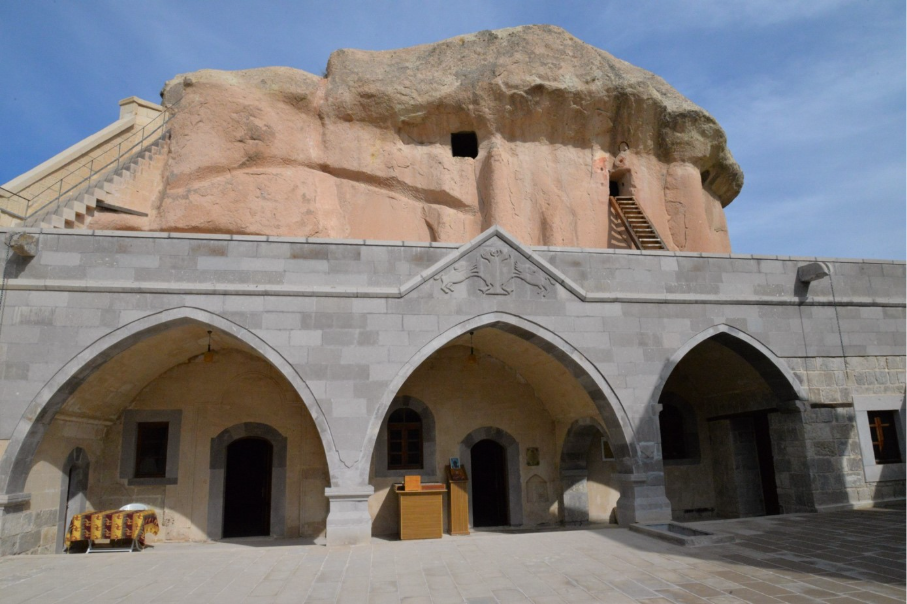
Church and Monastery of St Nicholas in Mustafapaşa(https://turkisharchaeonews.net/object/church-and-monastery-st-nicholas-mustafapaşa )
What makes the monastery particularly remarkable is that it functioned not only as a place of worship but also as a place of gathering. Historical accounts describe the spring within the monastery courtyard as possessing healing properties, attracting both Orthodox Christians and Muslim communities from the surrounding region.
Nearby, the Monastery Valley contains additional churches dedicated to saints such as Stephen and Basil, creating one of Cappadocia’s most concentrated collections of religious heritage sites.
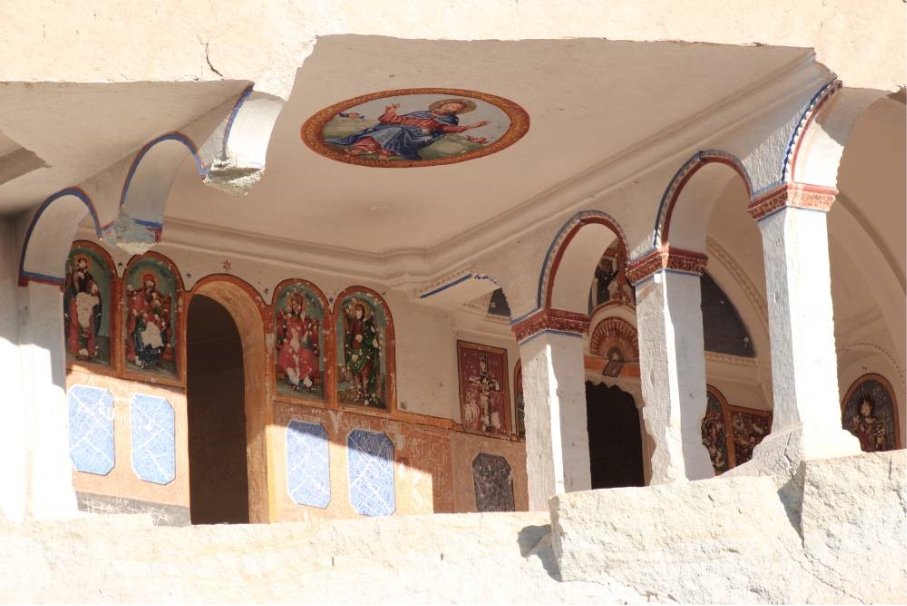
The Church of Saint Basil (https://mustafapasakapadokya.org/en/church-of-saint-basil/ )
Within the village itself, the Church of Constantine and Helena remains one of the most important surviving monuments of the Sinasos Greek community. Built on an earlier sacred site and later expanded, it reflects the importance of religious life within the village and stands as one of the most prominent ecclesiastical structures in Cappadocia.
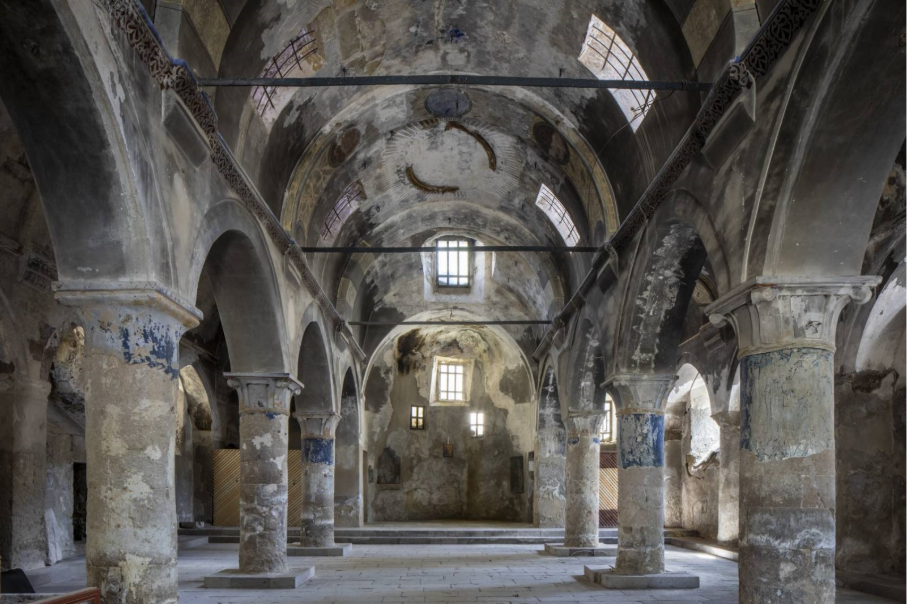
Church of Constantine and Helena (Eleni) (https://mustafapasakapadokya.org/en/church-of-constantine-and-helena-eleni/ )
Together, these structures reveal something larger than architecture.
They reveal a place where different communities, traditions, and beliefs coexisted for generations.
This layered identity is precisely what makes Sinasos so relevant today.
At a time when many hospitality developments risk becoming disconnected from local context, Sinasos offers something increasingly rare: authenticity that cannot be manufactured.
Its value is not found in a single building.
It is found in the relationship between architecture, landscape, religion, education, craftsmanship, and memory.
For future hospitality developments, this presents both an opportunity and a responsibility.
The challenge is not simply to preserve historic buildings.
It is to continue the cultural dialogue they represent.
Because Sinasos is not merely a destination.
It is one of Anatolia’s most complete surviving archives of cultural exchange, learning, spirituality, and human settlement.
And perhaps that is its greatest luxury of all.
.avif)